Posts

Understanding the Different Types of Forging Techniques and Their Applications

Image
  Forging is a manufacturing process that involves shaping metal into a desired form through the application of force. It is a popular technique used in many industries, including aerospace, automotive, and construction. There are several types of forging techniques , each with its unique applications and benefits. In this article, KDK Forging Co. will explore the different types of forging methods and their uses. Open Die Forging Open die forging is also known as free forging, and it is the simplest type of forging method. This process involves shaping the metal by hammering it between two flat dies. It is commonly used to produce large, simple shapes like cylinders, discs, and blocks. Eyebolts are a common application of open die forging, and they are used to securing loads to overhead cranes or lifting equipment. Closed Die Forging Closed die forging , also known as impression forging or precision forging, involves shaping the metal by placing it between two dies that are de...
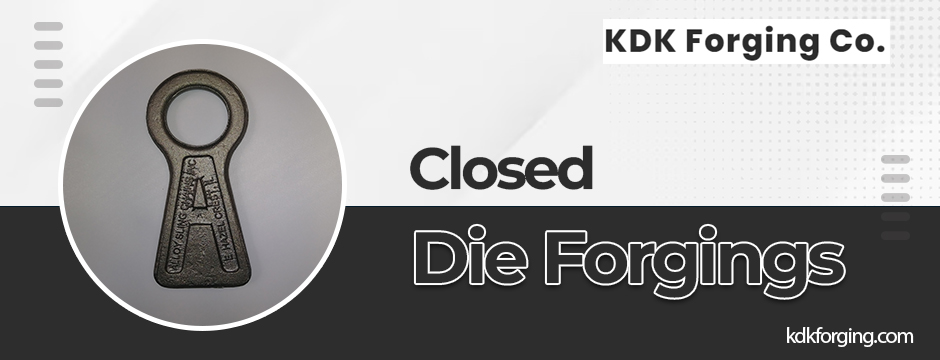
Closed Die Forgings - Things to Know!

Image
  There are several methods that entail dying forging when it comes to twisting and deforming metal works with closed die forgings . The forging methods of open and closed dies are two of them with the help. Both use the same fundamental techniques—heating and forcefully deforming metal—but they differ when it comes to the die plates themselves. Let's examine the definitions, distinctions, and many advantages and disadvantages of each die-forging technique. What is Open and Closed Die Forging Open-Die Forging? A piece of metal is forged with an open die, often referred to as free forging or smith forging, by striking it with a hammer while it is normally resting on a stationary anvil. Another strategy is to push the metal between simple dies using compression. Most frequently flat, semi-round, or V-shaped, these straightforward dies with the maintenance of eyebolts . The metal is never entirely enclosed during the open-die forging process, regardless of the die form. The metal is ...

What are the Different Types of Shaft Forging Processes?

Image
  Four different forging manufacturing methods are often employed to form metal components. These techniques include seamless rolling ring forging, cold forging, open die forging, and impression die forging (closed die). The shaft forging process offers a very effective approach to producing a variety of components for all purposes by applying localized compressive stresses. Cold Forging The cold forging technique is intended to produce parts and components with tight tolerance dimensions and an improved surface finish quality. In contrast to most other forging techniques, cold forging uses cooler temperatures to create a variety of components rather than heat to shape the part structure. Shafts, hollow items with stems and shafts, strange combinations, and cup-shaped geometries can all be produced using cold forging. Cold Forging Advantages Creates tight tolerances Produces good surface finish quality Economical Little to no material waste Dies last longer than those used for he...

Take an overview of closed die forgings from KDK Forging Co.

Image
One of the forging types for tiny or medium metal components is closed die forging , sometimes called impression die forging. In contrast to the open die forging method, the material is pushed to flow in a closed shape called a die during this plastic deformation process. This die forging can produce more intricate geometries that are extremely close to the final component's dimensions compared to open die forging. Rapid plastic deformation is produced by a few shots that push the material into the die's shape. Without any intermediary re-heating, the operation is carried out at the plastic temperature of the material used. Here KDK Forging Co. will provide an overview of the closed forging process.  Process Metal is inserted into a die resembling mould and linked to an anvil during closed forging. Typically, the hammer die is also formed. The metal then flows and fills the die cavities as the hammer is struck on the workpiece. Within milliseconds, the hammer repeatedly makes...

An overview of the upset forging process by KDK Forging Co.

Image
A metal bar is heated locally during upset forging, and the bar is then tightly held using specialized tooling while pressure is applied to the end of the bar in the direction of the axis to distort it. Long pieces with forged ends can be produced using this method. As opposed to the electro-upsetting method, upset forging does not permit as much variance between the original bar diameter and the forged head diameter. However, because the deformation is done in stages, it does enable the creation of considerably more intricate shapes. Here KDK Forging Co . will deliver an overview of the upset forging process .  Uses Shafts, screws, piston rods, and other lengthy parts for the automobile industry, public works, aviation, and many other fields of application are produced using upset forging. Production Upset forging can produce large quantities of elongated pieces as a continuation of hot forging. The creation of axisymmetric pieces with complex geometry is made possible by the he...

Everything to Know about Upset Forging Process

Image
  Metal is manipulated, shaped, deformed, and compressed during the forging process in order to obtain the required form, configuration, or appearance specified by a metal processing design or schematic with an upset forging Process Both hot and cold forging techniques can be used to finish the forging process, depending on the kind of metal and the design specifications. Forged parts play a crucial role in the mechanisms of modern machinery, types of machinery, and appliances. Steps to the Forging Process Metal has been shaped using various forging techniques for several thousand years. Forging has evolved with new metals and technological improvements but has mostly retained its fundamental shape. Metal must be shaped during forging, regardless of the technique. While the fundamental procedures differ, they are similar. Forging Process Metal The kind of metal determines which forging technique should be used in large part. Even though metals differ in weight, tensile strength, ...