Posts

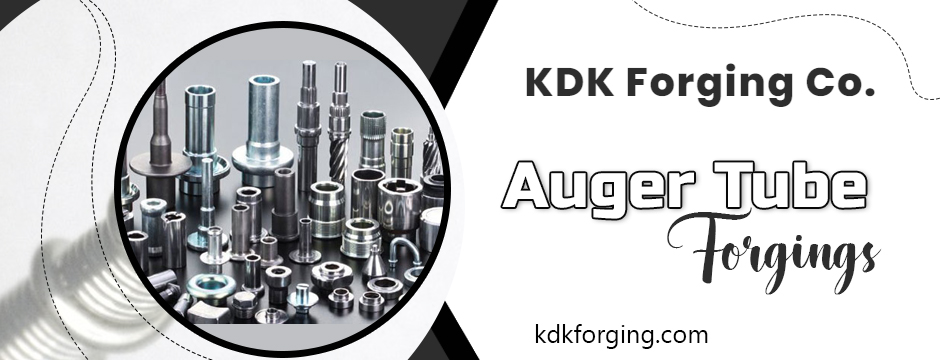
What are the benefits of auger tube forgings? Know it from KDK Forging Co.
Image
It is one of the most valid concerns if you are stuck between the differences between forging and casting. The process of forging involves applying tremendous pressure to forging dies to press steel billets into the required shape. A medium-frequency furnace heats a metal bar or billet to a specific temperature before being inserted between the dies for hammering, allowing it to fill the die cavity fully. Casting creates final shapes by pouring liquid steel water into molds, whereas forging creates shapes by producing the final shapes in a solid state. Following forging, the material's physical characteristics and grain structure are enhanced. Physical characteristics, including strength, flexibility, and toughness, are substantially better after dying forging than the raw material. Here KDK Forging Co. will provide the best advantages of auger tube forgings .  The best points to consider are: It helps to improve strength and properties.  The process guarantees better quality...

What are the benefits of upset extension forgings? Know it from KDK Forging

Image
  Uneven forging removes flaws in the material, such as micro-shrinkage, gas porosity, and low-density areas, and realigns the grain flow. It also breaks up the cast structure of the material. Here KDK Forging will discuss the advantages of upset extension forgings . The possible benefits are: Benefits of forging Forged parts have greater strength. It is less expensive and more dependable. It responds to heat treatment better. It gives better and more constant metallurgical characteristics. The size variety of things it offers is wide. Less secondary operations are needed. It is flexible in terms of design. What is agitation forging? Locally heating a metal bar, holding it tightly with specialized tooling, and then applying pressure to the end of the bar in the direction of its axis to deform it is known as upset forging. The method enables the creation of lengthy pieces with forged ends. The usage of upset forging Pressure causes the rod's length to decrease and its diameter to r...

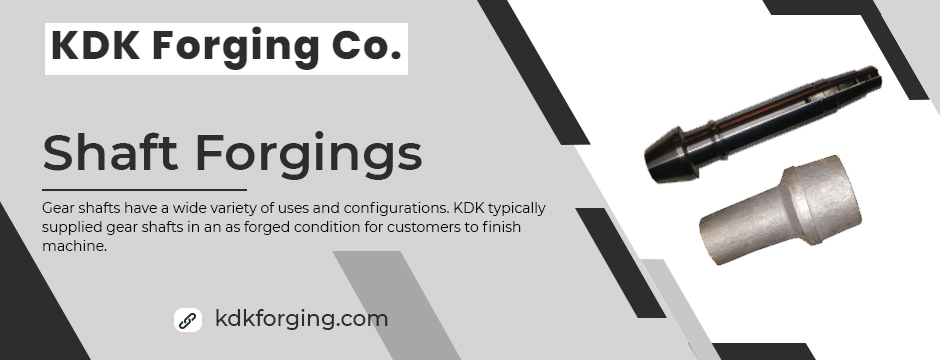
Explore the advantages of shaft forgings on steel from KDK Forging Co.

Image
  When you forge over steel, it will allow you to get the desired steel shape and make it more effective for industrial use. Steel forging is a unique advanced process that involves applying high pressure to forging dies to crush steel billets into desired shapes. In the closed die steel forging procedure, a metal bar or billet is heated by a medium frequency furnace to a certain temperature before being put between the dies for hammering so that it may fill the die cavity. As opposed to casting, which creates final shapes by pouring liquid steel water into moulds, forging creates shapes finalised in a solid state. The material's physical qualities and grain structure are enhanced during steel forging. Strength, flexibility, and toughness are substantially better after closed die forging than the raw material. If you want to know the benefits of shaft forgings on steel, KDK Forging Co. is here to answer all your queries and inform you of the advantages of the process.  The m...

A Brief Guide To Press Part Forgings

Image
  Forging is a manufacturing process  in which  a metal  is formed by  hammering,  pressing  or rolling. These compressive forces are delivered with a hammer or die. Forging is often  classified  according to the temperature at which it is  performed: cold, hot  or hot  forging. A  wide  variety  of metals can be forged. Typical metals used in forging  are  carbon steel, alloy  steel  and stainless steel. Very soft metals such as aluminum,  brass  and copper can also be forged. The forging process can produce parts with  excellent  mechanical properties with  a  minimum  of scrap.  The basic concept is that the original metal is plastically deformed  into  the desired geometric  shape, giving  it  greater  fatigue  strength  and strength. The process of press part forgings is  economical  with the abil...

Know The Importance of the Most Efficient Forging Technique for Industrial Usages

Image
 The worldwide forging market is advancing at a breakneck pace. The global forging industry is expected to grow at a CAGR of 4.4 percent between 2017 and 2025. Furthermore, the automotive industry currently consumes 65 percent of all forging products produced worldwide. The facts show a growing global demand for a metal forge. The   forging technique   is popular in high-precision industries such as aerospace, automotive, water distribution, fire systems, and automation, to mention a few. So, what creates forged products popular across industries? The following is a list of the advantages of using a metal forge. Strong and reliable: No other metalworking technique can guarantee the incredible strength of forged metal components. The forged metal's high strength is due to its tight grain structure. Forged products outperform cast, fabricated, and welded products in terms of ductility, reliability, and strength. It is frequently used for forged products in industries wher...

Know about The Importance And Major Benefits of Upset Extension Forgings

Image
  Upset extension forgings   entail locally heating a metal bar and then adding pressure to the bar's side in its axis's path to deform it while holding it firmly with special tooling.   Long parts with forged ends can be produced using this method. As with electro-upsetting, upset forging does not allow for as much variation between the beginning bar diameter and the forged head diameter. However, because the deformation is done in stages, it allows for much more complex geometries. Defining forging:   Forging is a manufacturing process that involves pressing metal under high pressure into high-strength preferred components. The process is usually (but not always) done hot by preheating the metal to the desired temperature before working with it.   It is important to note that the forging process is not the same as the casting process because the metal used to make forged components is never melted and poured as in the casting process.   Upset fo...

Why Should You Choose The Shaft Forging Process for Your Requirements?

Image
  The global forging industry is progressing at a breakneck pace. The global forging market is expected to grow at a 4.4 percent CAGR from 2017 to 2025, reaching a value of $96433.7 million by 2025. Furthermore, the automotive industry currently consumes 65 percent of all forging products produced worldwide. The stats prove a growing global demand for the   shaft forging process . So, what makes forged products popular across industries? It is popular in high-precision industries such as aerospace, automotive, water circulation, fire systems, and automation, to name a few. The following is a list of the advantages of using a metal forge. Why forging? Other metalworking processes cannot compete with forging in terms of structural integrity. Internal voids and gas pouches that can weaken metal parts are eliminated by forging. Forging provides superior chemical uniformity by dispersing the separation of alloys or non-metallic. ·          ...